


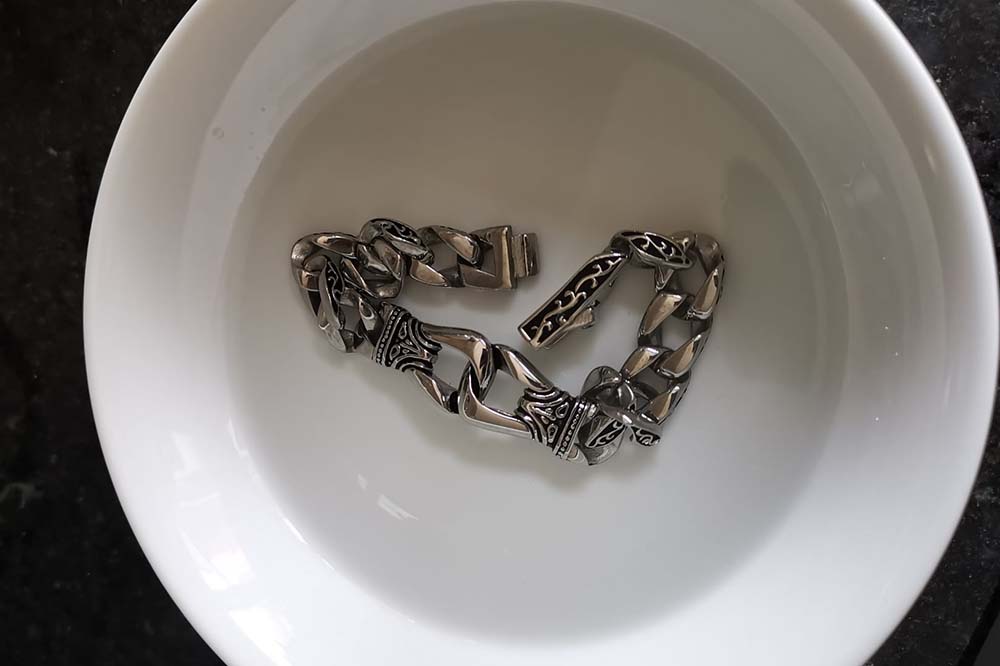
Activating stainless steel, chemically blackening and passivating
Obtaining a high-quality, durable and aesthetically pleasing black finish on stainless steel (SS) starts with the right preparation. Stainless steel – also known as stainless steel – does not rust under normal conditions thanks to a thin, passive chromium oxide layer that forms when ≥ 10% chromium in the alloy. This layer is self-healing: if damaged, the chromium oxide recovers as soon as the surface comes into contact with oxygen again. Additives such as nickel, molybdenum and titanium can further improve corrosion resistance, particularly in aggressive environments.
Activate and prepare
Be careful when working with acids! Use appropriate personal protective equipment and work in a well-ventilated area. Always read the safety data sheet (SDS) of the product in question (e.g. hydrochloric acid) first and do not continue working until you fully understand the hazards and measures.
For chemical blackening, the natural passive layer must first be removed. This can be done chemically (acid bath) or mechanically (sanding). This reveals the active metal surface, after which the black-oxide conversion layer can form. Without proper activation, the chrome will inhibit the reaction and the stainless steel may only turn light gray or not react at all; With extra hardened stainless steel, you can easily rub off the conversion layer again.
Etching Materials and Formulas
Etching agent: Galvanizing Metal Activator
Etching formula (acid bath): 10% to 50% hydrochloric acid (HCl) in water (v/v)
Etching paste (thixotropic): 100 ml water, 20 ml hydrochloric acid (ρ≈1.19), 30 ml nitric acid (ρ≈1.42), 150 g bentonite
Passivation of stainless steel
After etching/blackening, the passive chromium oxide layer recovers on its own within 24–48 hours due to exposure to air. You can speed up this process by passivating in a solution of citric acid in water.
Passivation with nitric acid (HNO3) is also common: it removes free iron and contaminants and helps to restore/strengthen the chromium oxide. A commonly used mixing ratio is
Step-by-step plan: preparation, rinsing, blackening and optional sealing
Step 1 — Removing the passive layer
Activate the surface in an acid bath or with Verzinkshop Metal Activator. The surface is now ready for chemical blackening.
Step 2 — Rinse thoroughly (do not let dry)
Rinse immediately and thoroughly with water to remove all acid residue. Do not let the stainless steel dry after etching (no contact with air/oxygen), otherwise the passive layer will immediately start to form again. Go wet to the black bath.
Step 3 — Chemical blackening
Dip the stainless steel in Verzinkshop Black Stainless Steel Oxide until the desired shade is achieved. Remove the workpiece from the bath and rinse thoroughly again.
Step 4 — Rinse thoroughly again
Rinse carefully with water again. Optionally, you can add a small amount of baking soda (sodium bicarbonate) to the last rinse water to neutralize residual acid. Always rinse again with clean water.
Step 5 — Passivation and (optional) sealing
Allow the passive layer to recover naturally (24–48 hours) or accelerate with a citric acid or nitric acid passivation as described above. Although stainless steel is inherently anti-oxide and does not require a sealer, you can opt for a sealer for extra protection and aesthetics, such as