
Free shipping from € 150

Unique assortment

Prices include VAT

Free advice from our specialists

Copper Electrolyte Alkaline

Price range: €29.95 through €399.95

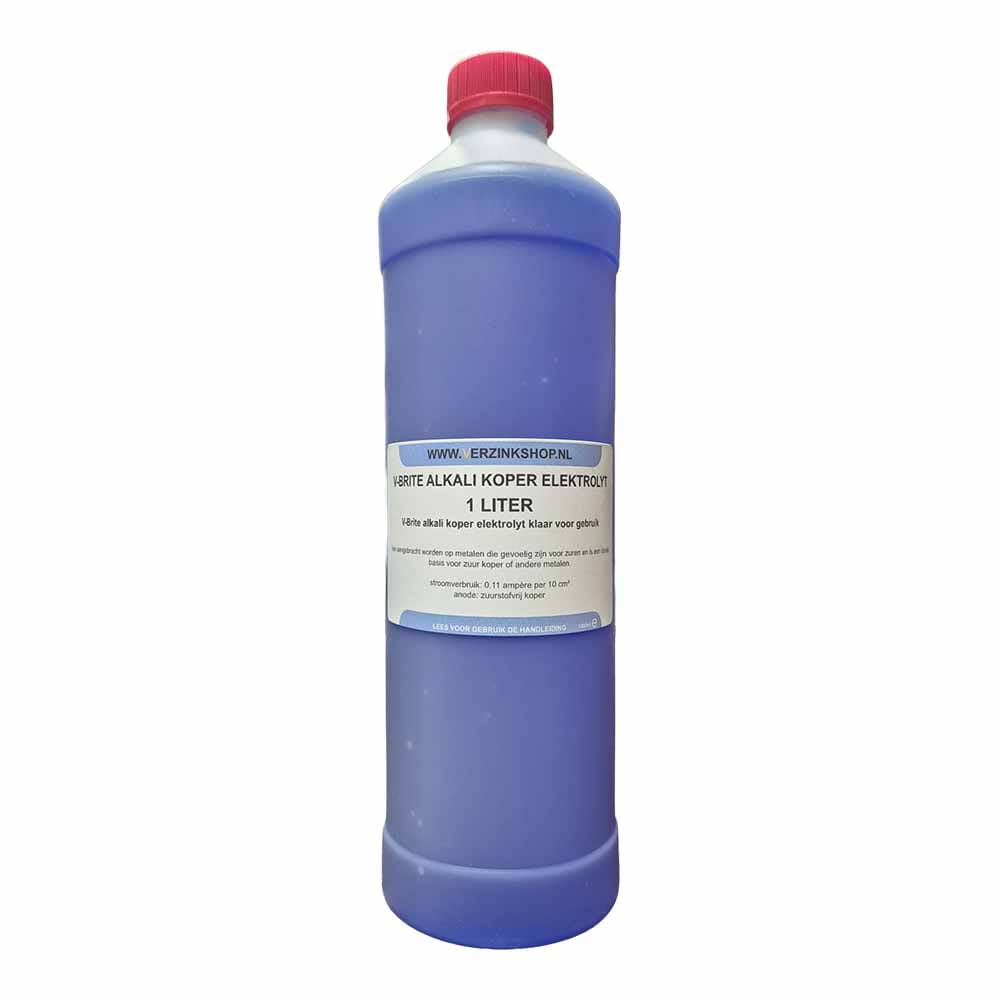
Verzinkshop V-Brite Alkali is a cyanide-free alkaline copper electrolyte for electrolytic copper-plating of metals and is delivered ready-to-use.

Copper Electrolyte Alkaline – Galvanizer V-Brite Alkali

NEW: Verzinkshop V-Brite Alkali electrolyte!
Expected 2nd–3rd week of February. Shipping starts the week after.
Available to order now. Orders with V-Brite Alkali will be shipped as soon as the product is in stock.


Verzinkshop V-Brite Alkali is a cyanide-free alkaline copper electrolyte for electrolytic copper-plating of metals and is delivered ready-to-use. V-Brite Alkali is applied as a finish or is used as an intermediate layer when an acidic copper electrolyte, or another electrolyte, cannot be applied directly to a metal, such as aluminum or stainless steel. After applying a copper layer with V-Brite Alkali, you can proceed with an acid copper bath or other metal finish.

The electrolyte is suitable for:

  • Zinc
  • Nickel
  • Steel
  • Stainless steel
  • Copper / Brass / Bronze
  • Aluminium (only after zincate)


The electrolyte is available in:

  • 1 liter
  • 2 liters
  • 5 litres
  • 10 litres
  • 25 litres

Need more? Please contact us .


What is V-Brite Alkaline Copper Electrolyte

V-Brite Alkali is an alkaline (basic) copper electrolyte. Unlike an acidic copper bath, this electrolyte is not acidic, making it suitable for bonding copper to metals that are affected by an acidic copper electrolyte or to which an acidic copper bath does not pick up.

V-Brite Alkali is mainly used as an adhesive/intermediate coat to apply a well-adhering copper base coat for subsequent coats. Think of:

  • Copper with acid copper electrolyte can only be applied to copper, nickel and brass. It is too acidic for other metals such as aluminum or zinc. By applying a layer of copper with V-Brite alkali, you have a good basis for acidic copper electrolyte.
  • Some electrolytes do not act directly on all metals – for example, Nickel on Zinc or Aluminum. By first applying a layer of copper with V-Brite Alkali, you can then use the desired electrolyte on that metal.


Features of Verzinkshop V-Brite Alkali Copper Electrolyte

  • Non-cyanide alkaline copper electrolyte
  • Strike (adhesive layer) and surface-mounted bath in one
  • Perfect interlayer for metals on which acid copper electrolyte cannot be used directly
  • Fine-grained, dense and ductile copper deposits with good adhesion
  • Very suitable as an adhesive layer before nickel, acid copper, silver or other metals
  • Ready-to-use electrolyte: ready to use


Technical specifications

  • Recommended starting current density: 0.11 amps per 10 cm² total area (≈ 1.1 A/dm²)
  • Metal source: anodes (oxygen-free copper)
  • Anodes: oxygen-free Cu-OF (CW008A/C10200) or Cu-OFE (CW009A/C10100) – no phosphorous copper
  • Works on: zinc/zamac, steel (after activation), stainless steel (after activation), copper, brass, nickel; Aluminium only after zincate
  • pH: 9.2 – 10.0
  • Operating range temperature: 38 – 60 °C
    • Optimal temperature: ± 49 °C
  • Agitation: pump or air (powerful agitation needed)


Preparing metals

This alkaline copper bath does not clean. A clean, activated substrate is therefore essential for adhesion and even deposition.
Preferably rinse 2–3× between steps (especially after an acid dip/activator) and do not let the workpiece dry between activation and the copper bath.

(download the manual under the downloads tab for more detailed information)


Basic steps (for all metals)

  • Degrease with an alkaline degreaser (e.g. V-Clean) and rinse well.
  • Activate/etch where necessary (see per metal below).
  • Rinse immediately 2–3× and proceed to the copper bath without drying.


Preparation by metal

  • Copper-plating iron/steel: short activation in dilute hydrochloric acid or dilute sulphuric acid (10–30 sec), then rinse for 2–3×. In case of adhesion problems: Metal Activator, then rinse.
  • Copper plating: activate with Metal Activator (warm) or a short (controlled) acid dip, then rinse for 2–3× and flush immediately.
  • Copper & brass copper plating: short dip in Metal Activator, then flush and straight through.
  • Nickel copper plating (electroless/electrolytic): short dip in 5–10% sulphuric acid solution (10–30 sec), then rinse 2–3× and flush immediately. Old/dull nickel: first degrease again and possibly mattify slightly.
  • Zinc copper-plating: degrease as briefly as possible, then briefly activate with Metal Activator (keep short), rinse 2–3× and flush immediately.
  • Galvanized steel copper plating: short activation with Metal Activator, then 2–3× flush and immediately through.
  • Aluminum copper plating: degreasing and rinsing, then first Zincate Aluminum Activator according to product instructions; Then rinse and go to the copper bath without drying.


Setting up the bath and electroplating it yourself

Copper-plating objects and parts yourself with this electrolyte is easy, provided you carry out the pre-treatment and rinsing properly.

  1. Pour the electrolyte into the bath. Bring the electrolyte up to temperature and turn on agitation (air or pump).
  2. Hang two oxygen-free copper anodes in the bath, preferably in polypropylene anode filters.
  3. Connect the red plus wire of the power supply to the anodes, leave the power supply off.
  4. Attach the workpiece to a staff and dip it into the electrolyte; Connect the black minus wire to the workpiece.
  5. Calculate the surface area to be copper-plated and set the power supply to approx. 0.11 amps per 10 cm² of object area.
  6. Seller until the surface is completely closed and opaque (often 10–30 minutes). Then rinse thoroughly immediately and move on to a next step (e.g. acid, copper, nickel) or drying/protecting.

Technical information

ElectrolyteAlkaline Copper V-Brite Alkali
metalcopper
Works onzinc/zamac, steel (after activation), stainless steel (after activation), copper, brass, nickel; aluminium only after zincate
anodeOxygen-free Cu-OF (CW008A/C10200) or Cu-OFE (CW009A/C10100) – no phosphorous copper
anode-hookUsage: Copper or Titanium pendant/basket (preferred). Do not use in solution: steel/stainless steel
Recommended Flow Density0.11 amps per 10 cm² (starting value)
pH value9.2 – 10.0 (optimum ± 9.6–9.8)
Rinse aidNot applicable
Time10 – 30 minutes (typically as an adhesion/strike)
agitationpump or air
Temperature operating range38 – 60 degrees Celsius
Optimal temperature+- 49 degrees Celsius
shelf lifeLong shelf life when used correctly (small baths usually without active maintenance)
metal issued byanode
anode filterPolypropylene

Dangers & Precaution

EN_SDS_2022-11-11_0104 SDS NL-nl

H-zinnen
  • H302 – Harmful if swallowed.
  • H315 – Causes skin irritation.
  • H318 – Causes serious eye damage.
  • H319 – Causes serious eye irritation.
  • H332 – Harmful if inhaled.
  • H335 – May cause respiratory irritation.
  • H373 – May cause damage to organs through prolonged or repeated exposure.
  • H400 – Very toxic to aquatic life.
  • H410 – Very toxic to aquatic life with long lasting effects.
  • H411 – Toxic to aquatic life with long lasting effects.
P-zinnen
  • P101 – If medical advice is needed, have product container or label at hand.
  • P102 – Keep out of reach of children.
  • P273 – Avoid release to the environment.
  • P280 – Wear protective gloves/protective clothing/eye protection/face protection.
  • P305+P351+P338 – IF IN EYES: Rinse cautiously with water for several minutes; remove contact lenses if present and easy to do; continue rinsing.
  • P310 – Immediately call a POISON CENTER/doctor.
  • P501 – Dispose of contents/container to ...

Reviews

There are no reviews yet.

Only logged in customers who have purchased this product may leave a review.
Select a Pickup Point